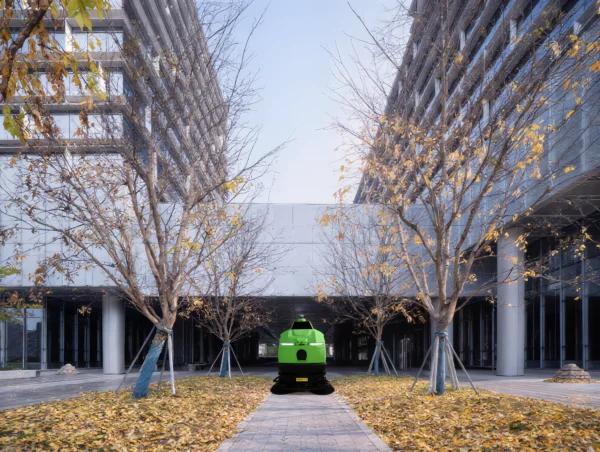
Plazas, parks, and commercial streets share a common operational challenge: manual crews with brooms or large motorized sweepers create bottlenecks. Workers compete for space with pedestrians, equipment blocks walkways, and peak-hour cleaning disrupts the public experience.
At the same time, facility managers face a shrinking labor pool. A 2025 industry study from Aspire found that 63% of commercial cleaning contractors identify staffing issues as their single largest risk factor.¹ The cleaning sector also continues to face rising labor costs, with providers forced to either absorb increased expenses or pass them on to clients.² The result is a growing gap between cleaning demand and available workforce.
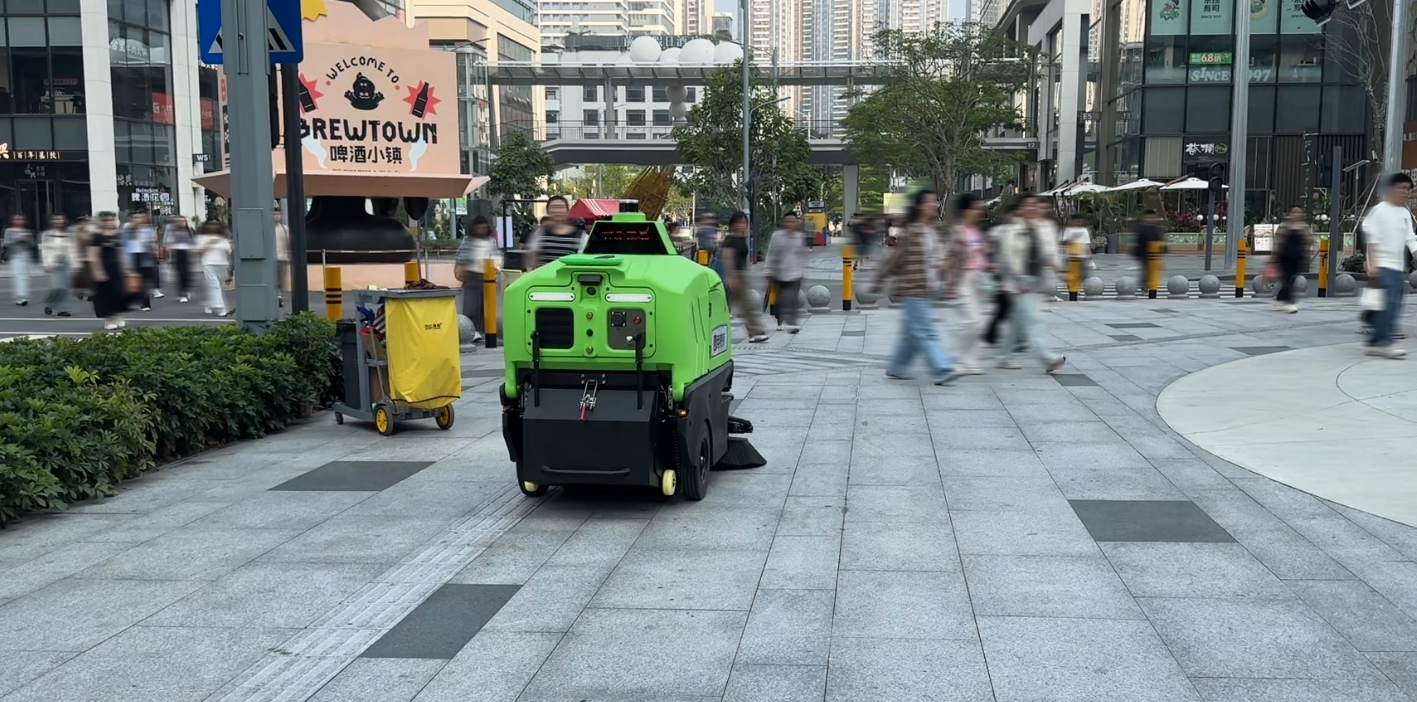
The outdoor cleaning robot market is growing in direct response to these pressures. Grand View Research reports that the outdoor segment of the cleaning robot market is expected to record the highest growth rate through 2030, driven by demand for automated solutions in large-scale commercial and industrial environments.³ Greendorph addresses this demand with two products designed for different crowd densities: the YJ130 uses autonomous driving with real-time obstacle avoidance to sweep continuously around pedestrians, while the YJ80 Series uses its Follow-Me mode to handle targeted cleaning tasks that require human judgment in tight or complex spaces.
How the YJ130 Cleans Safely in Crowded Outdoor Environments
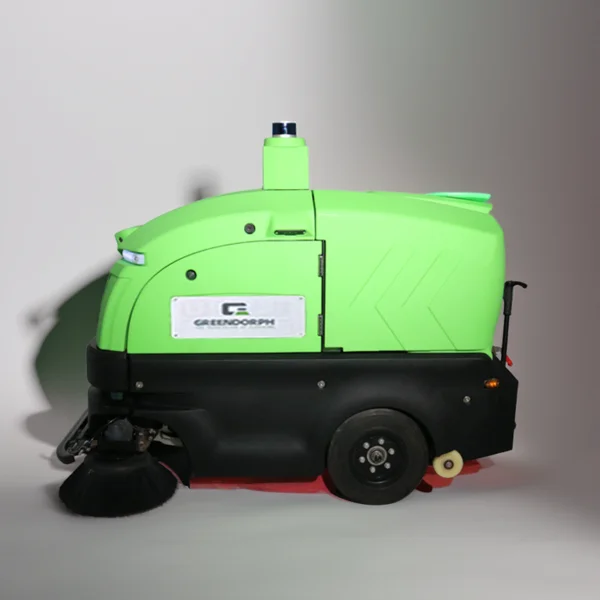
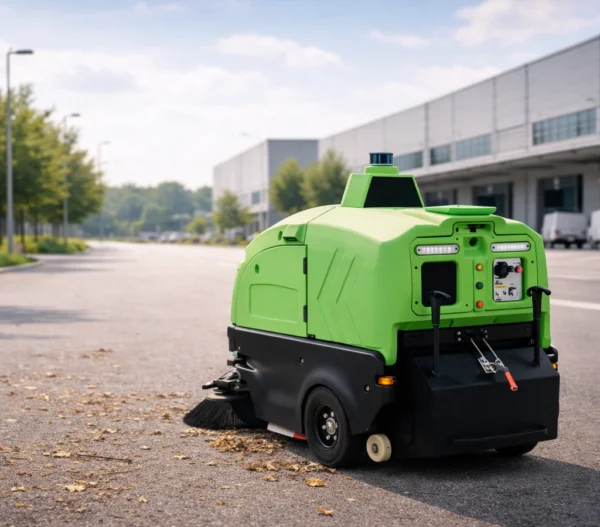
The YJ130 is an autonomous outdoor cleaning robot that operates without a human driver. In busy outdoor environments, its onboard sensors continuously scan for pedestrians and obstacles, allowing the machine to detect, slow down, and reroute in real time. This means the YJ130 does not need to wait for foot traffic to clear—it sweeps around people rather than avoiding the area altogether. Preset scheduling allows managers to plan cleaning frequency across the full day, from early morning through peak hours.
When the YJ130 does encounter pedestrians, its autonomous navigation system responds in real time. Onboard sensors detect people and obstacles, and the machine reroutes around them without stopping the cleaning cycle. This means the smart cleaning robot does not block pathways or force pedestrians to change direction—it adjusts its own path instead.
Dust is a particular concern in high-traffic outdoor zones, where sweeping can lift particles into the air that pedestrians breathe. The YJ130 addresses this with a misting spray system integrated into its triple cleaning mechanism (suction + airflow-assist + misting). The mist settles airborne dust during sweeping, maintaining air quality in populated spaces. Combined with a cleaning rate above 95%, this design keeps surfaces clean without creating secondary pollution.
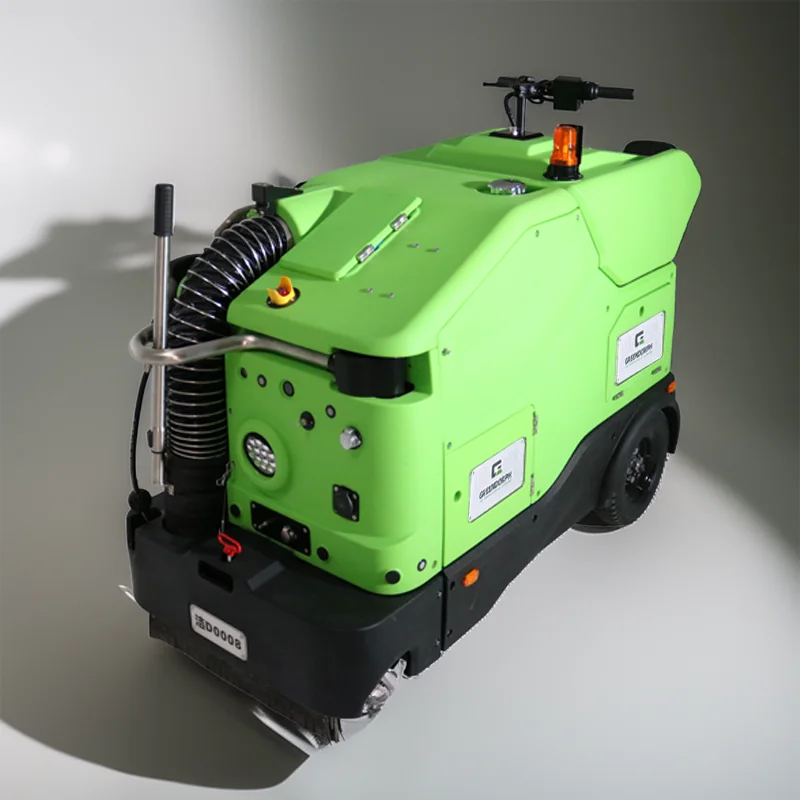
Operational continuity is another factor relevant to busy environments. The YJ130 handles water refilling, waste dumping, and battery recharging automatically. In practice, this means the machine completes its scheduled route without requiring a technician to intervene mid-cycle—eliminating service vehicle stops that would otherwise occupy space in pedestrian zones.
YJ80 Follow-Me Mode: Flexible Cleaning During Peak Hours
While the YJ130 handles general sweeping reliably across all traffic conditions, some situations call for real-time human judgment—post-event cleanup, mud removal after a rainstorm, or targeted stain washing in crowded commercial streets.
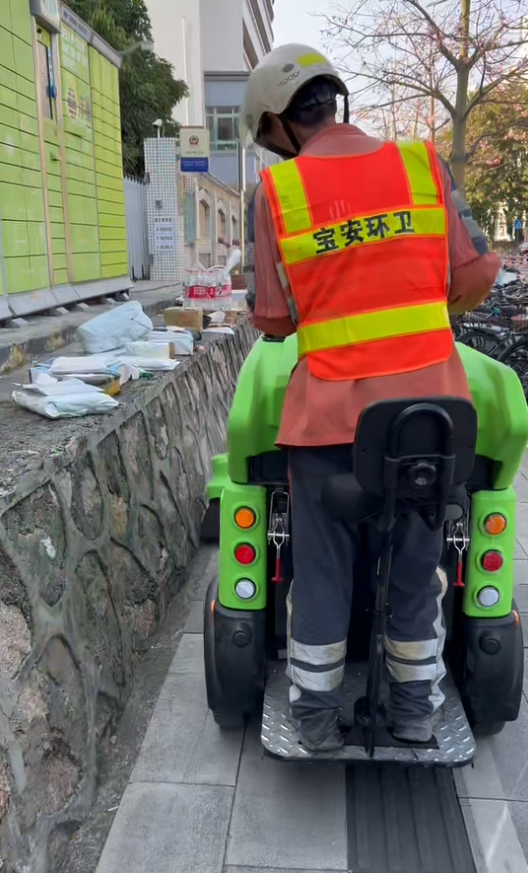
These situations call for real-time human judgment. The YJ80 Series meets this need through its Follow-Me mode, where an operator walks ahead and the machine trails at a set distance.
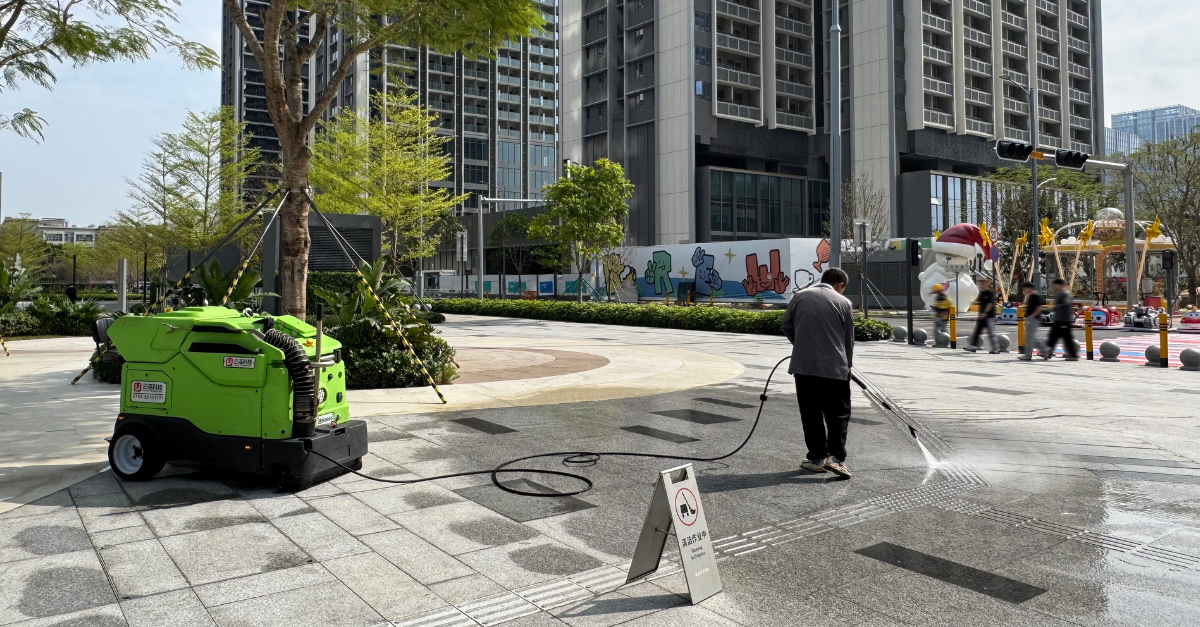
This setup lets the operator guide the commercial cleaning robot through crowds, making split-second decisions to avoid clusters of people, skip occupied benches, or reroute around temporary obstacles. The operator’s hands are free, and the machine handles the actual cleaning work: sweeping, vacuuming, and—in the case of the Hydro variant—high-pressure spot washing for stubborn stains between foot traffic.
The YJ80’s cleaning throughput supports rapid response even during busy periods. At 10,800 m² per hour and a movement speed of 6 km/h, the machine clears debris quickly enough to keep up with active use of the space. Its body width of 860 mm is narrower than a standard wheelchair, allowing it to pass through gaps on crowded sidewalks and packed plazas where a full-sized sweeper would block traffic.
For event cleanup or post-rain mud removal, the YJ80 Hydro variant adds high-pressure water washing without requiring a separate piece of equipment. The operator can switch from dry vacuuming to wet washing on the spot, targeting specific stained areas while the surrounding space remains open to pedestrians.
Deployment Strategy: Using Both Products on the Same Site
Many high-traffic outdoor facilities are not uniform. They include wide-open plazas, narrow side streets, main roads, and areas with varying crowd densities throughout the day. Deploying both the YJ130 and YJ80 on the same site creates a layered cleaning system that adapts to these conditions.
Time-Based Deployment
The YJ130 runs autonomous general sweeping throughout the day, covering the bulk of routine cleaning regardless of traffic volume. The YJ80 is then scheduled for targeted tasks at specific times—post-lunch deep wash in food court areas, end-of-day stain removal, or event cleanup. This time-based split assigns volume work to the YJ130 and precision work to the YJ80.
Zone-Based Deployment
Open main roads and central plazas suit the YJ130’s autonomous operation—the machine follows mapped routes along wide, unobstructed pathways. The YJ80, with its 860 mm width, handles narrow sidewalks, alleyways, and zones with dense street furniture. Each machine operates in the environment it was designed for, eliminating the compromises that come from using a single machine type across mixed terrain.
Function-Based Deployment
Daily dry sweeping is assigned to the YJ130, which handles leaves, dust, and light debris on a pre-set schedule. Periodic deep cleaning—oil stain removal from food courts, gum removal from pedestrian walkways, mud wash-down after storms—is assigned to the YJ80 Hydro variant. This division matches machine capability to task type: the YJ130 maintains baseline cleanliness, and the YJ80 addresses intensive cleaning needs that require wet functions and operator oversight.
| Strategy | YJ130 Role | YJ80 Role |
|---|---|---|
| Time-Based | All-day autonomous general sweeping across peak and off-peak hours | Peak-hour Follow-Me cleaning with operator guidance |
| Zone-Based | Wide main roads and open plazas | Narrow sidewalks, alleyways, dense-furniture zones |
| Function-Based | Daily dry sweeping and dust suppression | Periodic deep wash, stain removal, wet cleaning |
A Cleaning System That Works Around People, Not Against Them
The central problem in high-traffic outdoor cleaning is timing and space: cleaning must happen continuously, but it cannot interfere with the people who use these spaces. The YJ130 addresses this through autonomous operation with real-time obstacle avoidance, maintaining continuous sweeping even during busy periods. The YJ80 addresses it through operator-guided flexibility that adapts to real-time crowd conditions.
Together, these two outdoor cleaning robots form a system where daily maintenance runs unmanned, and targeted responses to spills, events, and weather-related messes receive focused human-robot attention. Neither product requires the facility to choose between cleanliness and pedestrian experience.
As the commercial cleaning robots market continues to expand, the operational question for facility managers shifts from “whether to automate” to “how to integrate automation into existing workflows.” Greendorph’s dual-product approach provides one answer: match the machine to the moment.
To explore how the YJ130 and YJ80 can work together at your facility, contact Greendorph for a site-specific cleaning plan.
References
- “2025 Commercial Cleaning Trends & Industry Insights.” Aspire, 2025, www.youraspire.com/blog/commercial-cleaning-insights-report.
- “2026 Cleaning & Facility Management Trends Businesses Should Prepare For.” DBS Building Solutions, Dec. 2025, dbsbuildingsolutions.com/2026-cleaning-facility-management-trends-every-business-should-prepare-for-in-2026/.
- “Cleaning Robot Market Size & Share | Industry Report, 2030.” Grand View Research, 2025, www.grandviewresearch.com/industry-analysis/cleaning-robot-market.