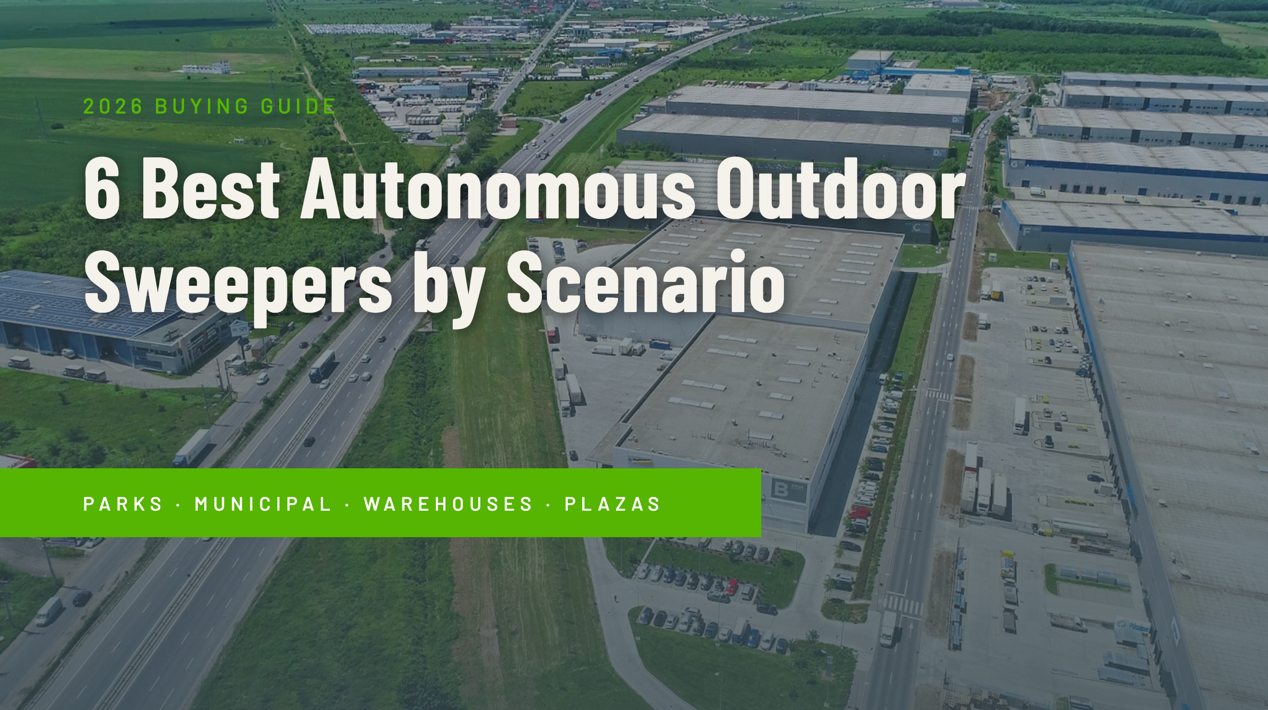
Picking an autonomous outdoor sweeper by star rating doesn’t work, because the “best” machine depends entirely on your site. A 200,000 m² industrial park and a covered parking garage need completely different equipment, and buying the wrong autonomy level means either paying for unused capability or missing coverage you actually need.
This guide sorts the leading autonomous and semi-autonomous outdoor sweeping options by the scenario they fit best, evaluated against five criteria: autonomy level, site-size fit, surface and weather adaptability, software and fleet management, and service support.
By the end, you’ll have a shortlist matched to your site type, with the tradeoffs and honest limitations of each option laid out for direct comparison.
Quick-Scan Comparison
| Rank | Best For | Width | Runtime | Autonomy | Best Fit |
|---|---|---|---|---|---|
| 1 | Mid-to-Large Outdoor Sites | 1.3m | 6-8h | Fully autonomous | Parks, campuses, industrial parks |
| 2 | Municipal & Large Industrial Districts | 2m+ | 4-8h | Fully | Ports, city |
| 3 | Mixed Indoor-Outdoor & Flexible Modes | 1.4m | 6-8h | Manual / auto-follow / towed | Malls, narrow streets, plazas |
| 4 | Semi-Outdoor Spaces | Compact | 4-6h | Semi-autonomous | Garages, atriums, covered plazas |
| 5 | Mid-Size Open Outdoor Areas | 1-1.3m | 4-6h | Fully or semi-autonomous | Parks, mid-scale commercial lots |
| 6 | Budget-Conscious Buyers | Entry | 3-5h | Semi-autonomous | Small lots, low-traffic paths |
How We Evaluated
Every entry below was assessed against five factors that determine real-world fit rather than spec-sheet appeal: autonomy level (fully unmanned vs. operator-guided), site-size fit (does the coverage rate match the ground you need cleaned), surface and weather adaptability (hard outdoor surfaces, rain, dust), software and fleet management (route logging, remote monitoring), and service support (setup time, local availability). Machines that score well on unattended reliability rank higher for large sites; machines that score well on maneuverability rank higher for tight ones.
The Ranked List
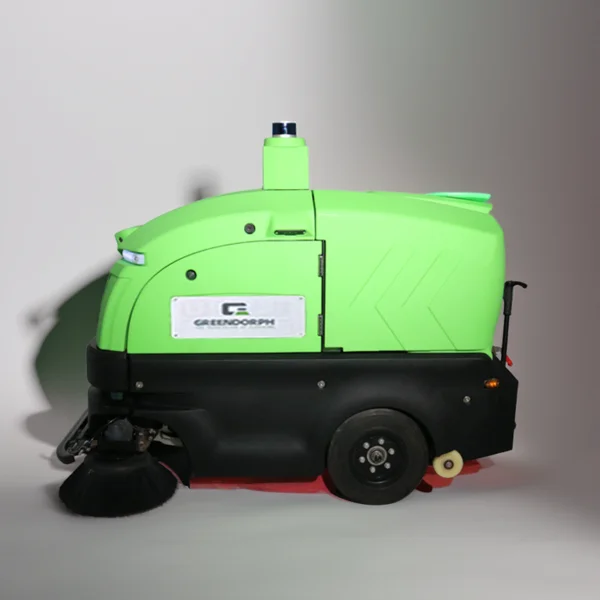
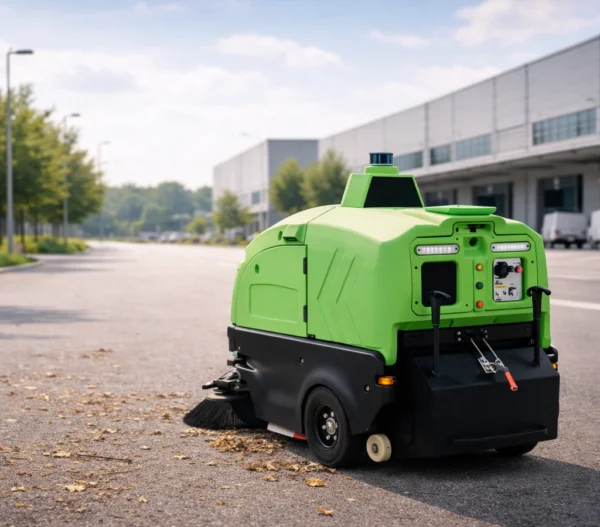
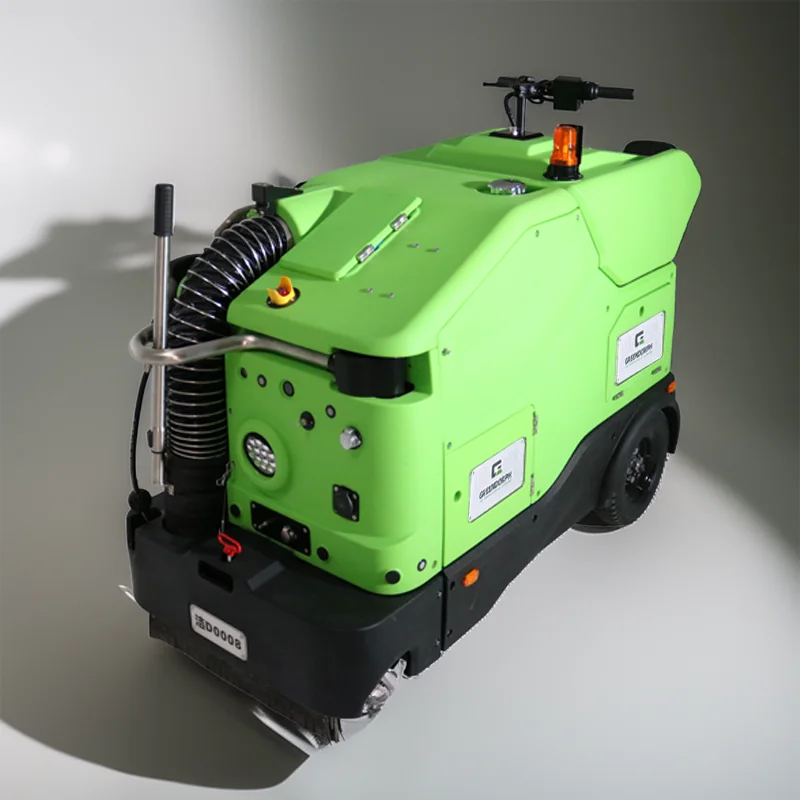
1. Greendorph Auto Sweeper YJ130
Best for: Mid-to-large outdoor sites needing unattended, scheduled coverage
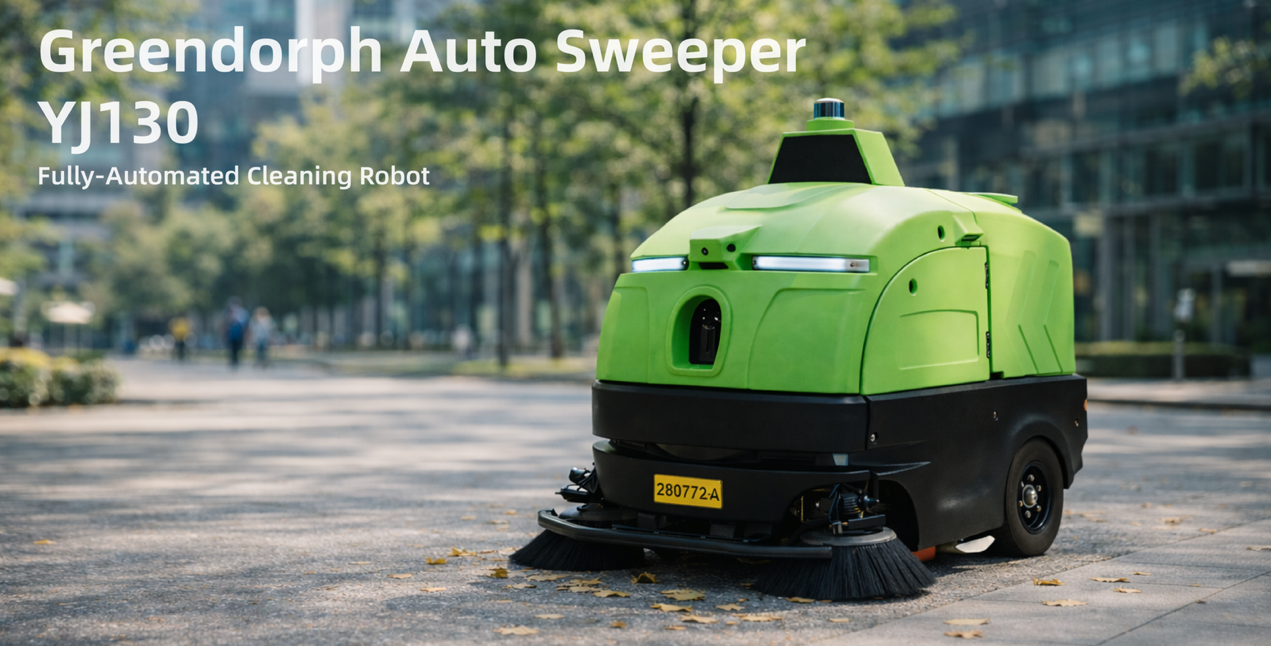
Greendorph is the outdoor cleaning robot line of Shenzhen Yunjie Technology, a Chinese manufacturer whose core engineering team includes graduates from Hong Kong University of Science and Technology and Harbin Institute of Technology [3]. The YJ130 is the flagship of Greendorph’s autonomous cleaning lineup, fully autonomous by design.
What stands out:
- 130 cm cleaning width at 5,760 m²/h, with auto water refill, auto waste dumping, and auto recharging for unattended route completion [3]
- 360-degree obstacle detection via multi-line LiDAR, single-line LiDAR, 3D cameras, and ultrasonic sensors, with long-range sensing to 150 meters [3]
- 150-liter debris bin and 100-liter water tank on a 48V/200AH LFP battery, running 6-8 hours per charge [3]
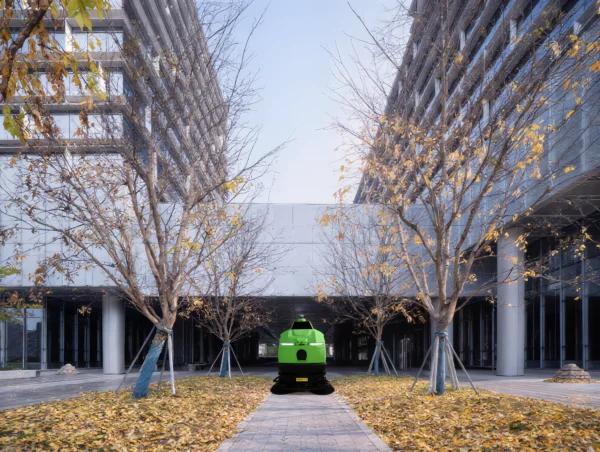
Consider if: You have a large, continuous outdoor site (parks, campuses, industrial parks) and want a single unit to run scheduled routes without an operator present.
Watch for: The YJ130 is built for outdoor hard surfaces only. It isn’t designed for indoor carpet cleaning, and Greendorph doesn’t currently offer a scrubber product for polished indoor floors [3].
2. Large-Format Municipal & Industrial Sweeper Class
Best for: Municipal streets, ports, and large-scale industrial districts
This category covers the largest fully autonomous outdoor sweepers on the market, generally built for city public works departments and industrial districts that need to cover multiple city blocks or a full port facility in a single shift [4]. These machines typically prioritize continuous operation over maneuverability.
What stands out:
- Widths and tank capacities scaled well beyond mid-size machines, since a single unit is expected to cover ground equivalent to several manual crews per shift [4]
- Fully autonomous navigation with lane-keeping and collision avoidance suited to shared traffic environments, distinguishing this tier from semi-autonomous smaller-city models [4]
- Typically deployed for off-peak operation, cleaning during low-traffic hours to avoid disrupting daytime activity [4]
Consider if: Your site spans multiple city blocks, a port, or a large industrial complex where a mid-size unit would need several passes to finish a route.
Watch for: Machines in this class carry a higher upfront cost and generally need dedicated depot and charging infrastructure, which makes them a poor fit for single-building sites.
3. Greendorph Omniclean YJ80
Best for: Mixed indoor-outdoor spaces and flexible multi-mode operation
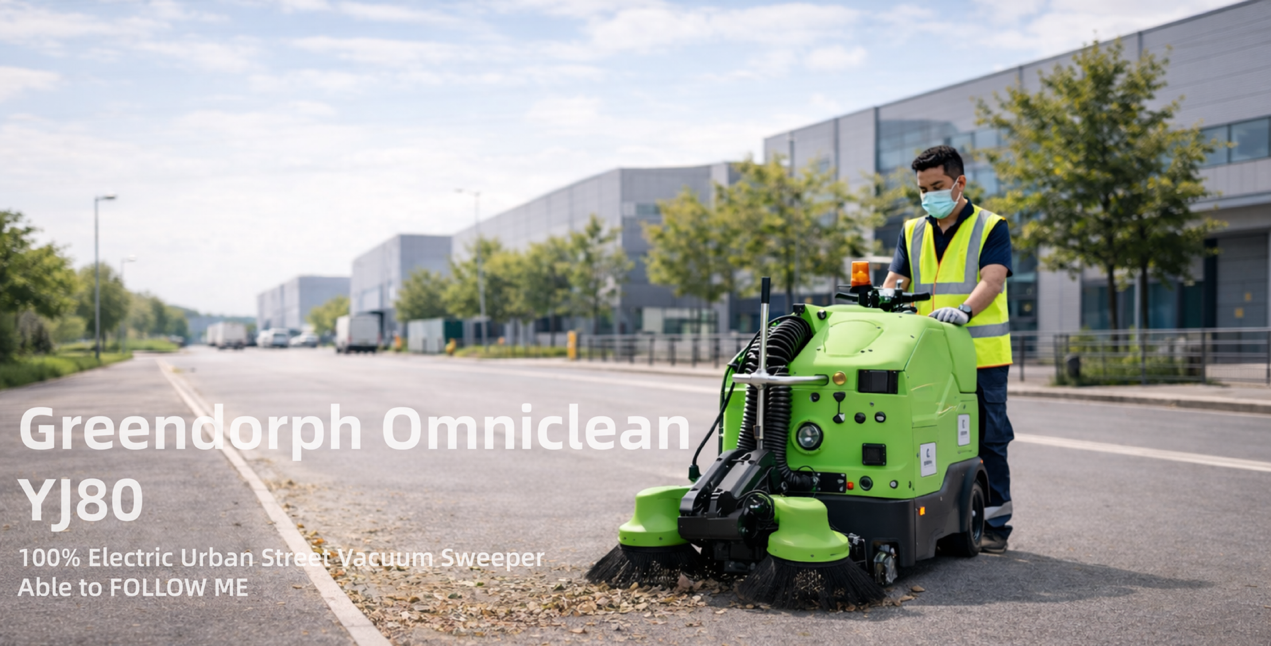
The YJ80 is Greendorph’s ride-on sweeper, built around operator flexibility rather than full autonomy. It shares the same 60-plus patent portfolio and outdoor-hard-surface engineering focus as the YJ130.
What stands out:
- Three control modes in one chassis: manual ride-on, auto-follow, and towed traction [5]
- 140 cm cleaning width at 10,800 m²/h, faster raw coverage than the YJ130, in a compact 860 mm body [5]
- Six-in-one dry and wet functions: sweeping, vacuuming, blowing, water spraying, and high-pressure washing [5]
Consider if: Your site has tight turns, seasonal layout changes, or a mix of dry and wet cleaning needs — common in commercial and retail spaces — where a fully autonomous route would be harder to maintain.
Watch for: Someone needs to be present or nearby to operate or supervise the YJ80. It isn’t the pick for sites that specifically need zero operator involvement.
4. Compact Semi-Outdoor Robot Class
Best for: Garages, atriums, and covered plazas
This category sits between indoor commercial scrubbers and full outdoor sweepers, built for covered or partially enclosed spaces like parking structures and building atriums [4]. Compact frame sizes matter more here than raw tank capacity.
What stands out:
- Narrower bodies designed to navigate parking-structure columns and atrium furniture without the wider turning radius that larger outdoor units need
- Weather sealing rated for splash and light moisture exposure rather than full outdoor rain conditions, since these units rarely operate fully exposed
- Positioned as a bridge product for facilities that have both an outdoor lot and an adjoining covered structure
Consider if: Your cleaning need is mostly under a roof, even if the space technically counts as “outdoor” (parking garages, covered walkways).
Watch for: The compact frame that helps in tight covered spaces usually means a smaller tank and shorter runtime than dedicated large-site outdoor sweepers.
5. Mid-Size Open-Outdoor Class
Best for: Parks and mid-scale commercial outdoor lots
This tier covers open-air sites too large for a compact semi-outdoor unit but smaller than a full municipal deployment, typically parks, small campuses, and mid-size commercial lots [4].
What stands out:
- Cleaning widths generally in the 1-1.3 meter range, positioned between compact semi-outdoor units and large municipal-class machines
- A mix of fully autonomous and semi-autonomous options within this tier, since site owners at this scale often want the choice rather than being locked into one operating model
- Positioning aimed at buyers upgrading from manual crews for the first time, rather than fleets already running larger autonomous units
Consider if: Your site is bigger than a parking garage but doesn’t need municipal-scale coverage. A mid-tier machine avoids paying for capacity you won’t use.
Watch for: Because this tier spans a wide range of vendors and specs, coverage rate and runtime vary significantly between models, so site measurements matter more here than in more standardized categories.
6. Entry-Level Outdoor Sweeper Class
Best for: Budget-conscious buyers with smaller or lower-traffic sites
This tier trades some autonomy and capacity for a lower purchase price, aimed at smaller lots, low-traffic walkways, and buyers testing automated cleaning for the first time [4].
What stands out:
- Lower upfront cost than mid-size or large-format machines, generally reflecting a smaller chassis and reduced sensor redundancy
- Semi-autonomous or manual-guided operation is more common at this tier than full autonomy
- A reasonable entry point for a facility piloting automation before committing to a fleet-scale purchase
Consider if: You’re testing whether automated outdoor cleaning fits your operation before scaling up, or your site genuinely doesn’t need large-site capacity.
Watch for: Reduced sensor coverage and shorter runtime mean more frequent charging cycles and less unattended reliability than higher tiers.
How to Choose an Autonomous Outdoor Sweeper
Area scale. Sites under roughly 10,000 m² fit mid-size or compact units; 10,000-50,000 m² typically call for mid-to-large machines like the YJ130; above 50,000 m², a large municipal-class unit or a multi-unit fleet makes more sense.
Environment type. Fully outdoor, semi-outdoor (garages, atriums), or mixed sites each favor a different weight class, as covered in the entries above.
Autonomy level. Full autonomy pays off on large, continuous, low-obstacle ground. Semi-autonomous or follow-me modes win on tight, irregular, or frequently reconfigured sites where a human can reroute faster than an algorithm.
Weather and protection rating. Confirm the machine’s rated Ingress Protection (IP) exposure to rain and dust matches your climate; semi-outdoor units are often only splash-rated, not built for sustained rain.
Battery and docking infrastructure. Fully autonomous units need a dedicated charging dock and, for water-based cleaning, a refill point; plan for that infrastructure before committing to a route length.
Software and fleet management. Route logging and remote monitoring matter most for multi-site operators and any facility that needs to show documented cleaning cycles for compliance or audit purposes.
Service network and local support. Setup, mapping, and ongoing maintenance require local support access; confirm response times before a large-site deployment.
Total cost of ownership. Compare purchase price against labor hours displaced, not just against other machines’ sticker prices; a higher-tier machine often pays back faster on large sites than a cheaper unit that needs more frequent operator attention.
FAQ
What’s the difference between autonomous and semi-autonomous outdoor sweepers?
Fully autonomous sweepers navigate, clean, and return to charge without an operator present, suited to large open sites with predictable layouts. Semi-autonomous or follow-me models keep a human in or near the loop, trading some unattended coverage for faster handling of tight or changing spaces [4].
Do autonomous outdoor sweepers work in rain?
It depends on the unit’s IP rating. Outdoor-rated models are generally built for exposure to rain and dust, while semi-outdoor units are often only splash-rated. Check the specific weather rating before committing to a fully exposed route.
How much does an autonomous outdoor sweeper cost?
Pricing varies by tier, roughly following the capacity classes in this guide: entry-level units cost less but cover less ground per hour, while large municipal-class machines cost more but displace more manual labor per shift. Get a quote based on your actual site measurements rather than list pricing.
Can one robot cover both indoor and outdoor cleaning?
Generally no. Outdoor hard-surface sweepers like the YJ130 and YJ80 aren’t built for indoor carpet cleaning, and indoor scrubbers aren’t built for outdoor debris and weather exposure. Most facilities with both needs run separate equipment for each.
How much labor does an autonomous sweeper replace?
This depends heavily on site size and current staffing, and reliable figures require a site-specific assessment rather than a blanket industry number. A demo or pilot on your actual site measurements is the most reliable way to estimate labor displacement.
Conclusion
If you’re running a large, continuous outdoor site, a fully autonomous unit like the Greendorph YJ130 fits scheduled unattended coverage. Tight, mixed-use, or dry-and-wet spaces favor operator-flexible options like the YJ80. Municipal-scale and semi-outdoor covered spaces sit at the two ends of the spectrum this guide covers, each with its own weight class of equipment.
Whichever tier fits your site, matching capacity to actual square footage matters more than chasing the highest spec sheet. If you’re not sure where your site lands, a demo request with real site measurements is a faster path to an answer than comparing specs alone.
Sources
- “Global Outdoor Commercial Cleaning Robot Trends: Region-Specific Insights 2026-2034.” Data Insights Market. https://www.datainsightsmarket.com/reports/outdoor-commercial-cleaning-robot-31495
- “Cleaning Robot Market Size and Share Analysis.” Mordor Intelligence, January 2026. https://www.mordorintelligence.com/industry-reports/cleaning-robot-market
- “Greendorph Auto Sweeper YJ130 – Robot Floor Cleaner.” Greendorph (Shenzhen Yunjie Technology Co., Ltd.), 2026. https://greendorphrobot.com/robot-floor-cleaner-greendorph-auto-sweeper-yj130/
- “Autonomous Street Sweeper Market Research Report 2033.” Dataintelo. https://dataintelo.com/report/autonomous-street-sweeper-market
- “Greendorph Omniclean Urban Street Sweeper YJ80 – Robot Floor Cleaner.” Greendorph (Shenzhen Yunjie Technology Co., Ltd.), 2026. https://greendorphrobot.com/robot-floor-cleaner-greendorph-omniclean-urban-street-sweeper-yj80/