Cleaning quality is not only about how much dirt is removed. In commercial sites, logistics areas, public spaces, and industrial facilities, the process also needs to be repeatable and easy to manage. A stable routine can reduce missed zones, limit unnecessary contact with hazards, and help teams keep daily standards more consistent.
For B2B operators, this is where floor cleaning machines can support a more structured workflow. Mechanical cleaning can combine sweeping, washing, dust control, route planning, and remote monitoring in one process. The value comes from reducing variation between shifts while giving supervisors clearer ways to review how cleaning work is carried out.
Safety Starts with a Controlled Cleaning Process
Manual cleaning often depends on individual habits. One worker may follow a fixed route, while another may skip corners or change the cleaning order. In busy facilities, this variation can create wet areas, missed debris, or repeated work. A defined machine route makes the cleaning sequence easier to standardize and review.
A machine for cleaning floors can also reduce the time workers spend close to moving vehicles, dusty areas, waste collection points, or other active zones. This does not remove the need for site safety rules. It changes how people are involved, especially when routine work can be completed with less direct exposure.
Obstacle sensing adds another layer of control. Multi-sensor systems can detect people, objects, curbs, and low obstacles while the machine is moving. The purpose is to give the machine more information about its surroundings so speed, direction, and stopping behavior can respond to changing conditions.
Site teams should still define cleaning zones, restricted areas, charging points, water refill locations, and emergency steps before operation begins. Safety depends on both the equipment and the way the site manages it.
Consistency Depends on Coverage and Route Design
Cleaning results often become uneven when different workers use different routes. One shift may spend more time in open areas, while another focuses on entrances or visible dirt. Route planning helps reduce this variation by defining where the machine should travel and how often each zone should be covered.
Edge cleaning also matters because dirt often collects beside curbs, walls, planters, and road boundaries. Machines with extendable side brushes or close-edge movement can reduce manual rework. For buyers, edge distance, cleaning width, turning space, and route flexibility should be reviewed together.
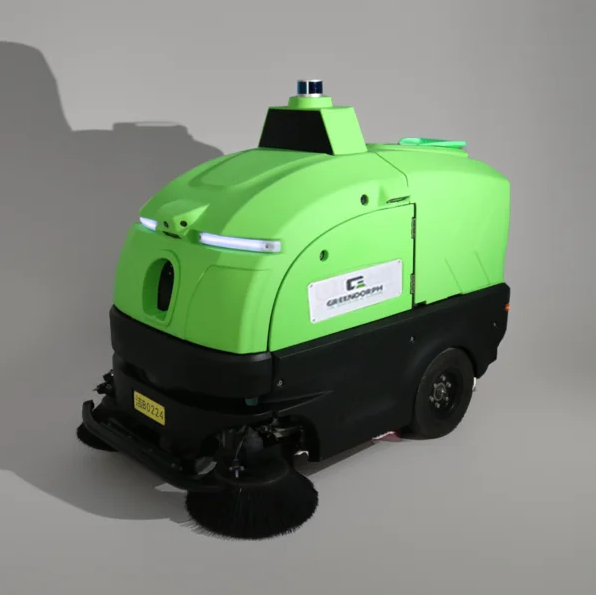
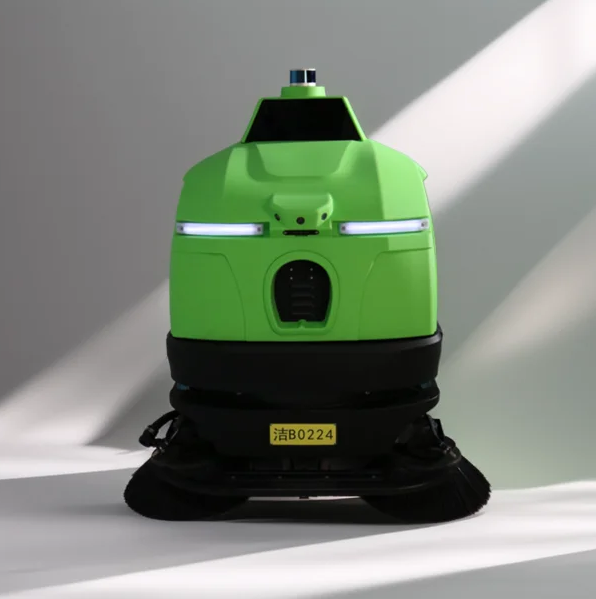
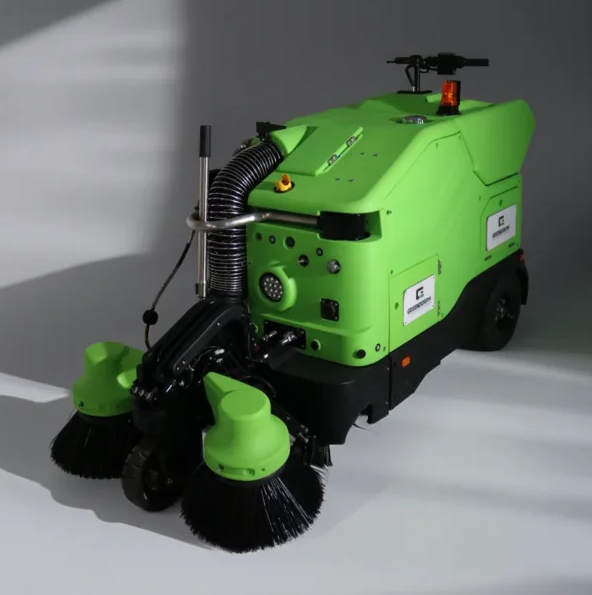
The Greendorph YJ130 is designed for autonomous outdoor cleaning. It supports breakpoint resume, remote mapping, on-site mapping, dust suppression, and edge cleaning with a minimum gap of 10 cm. Its perception system combines multi-line LiDAR, single-line LiDAR, 3D cameras, ultrasonic sensors, and anti-collision sensors to support environmental awareness.
Consistency also depends on what happens after an interruption. If water needs refilling, the waste bin needs emptying, or charging is required, a machine that records progress can return to the unfinished area rather than restarting the whole route. This helps reduce duplicated work and makes task completion easier to track.
Cleaning Functions Should Match the Site
Not every site needs the same cleaning method. Fine dust, leaves, loose litter, stains, and wet debris require different treatment. Buyers should first identify the main type of contamination, then compare sweeping, washing, high-pressure rinsing, dust suppression, and waste collection functions against the site environment.
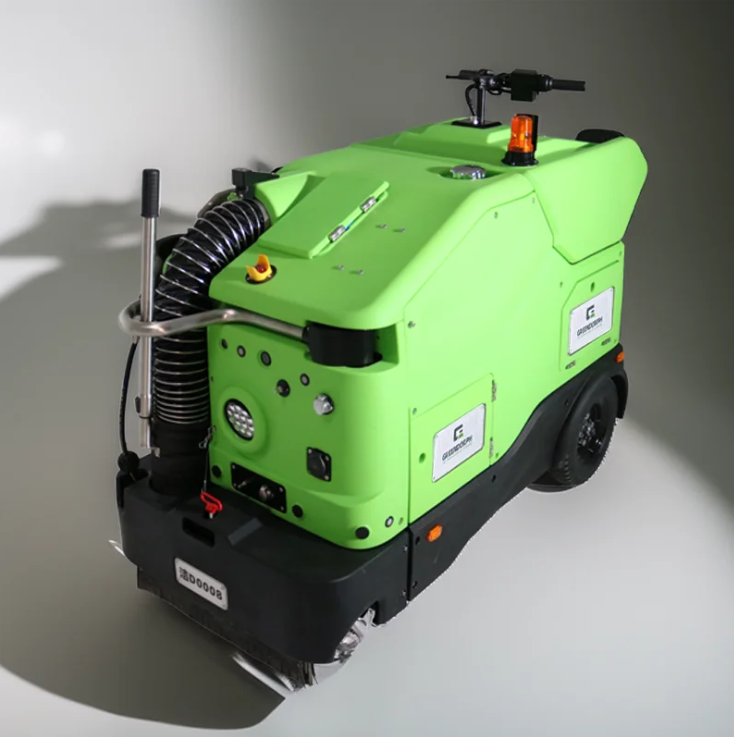
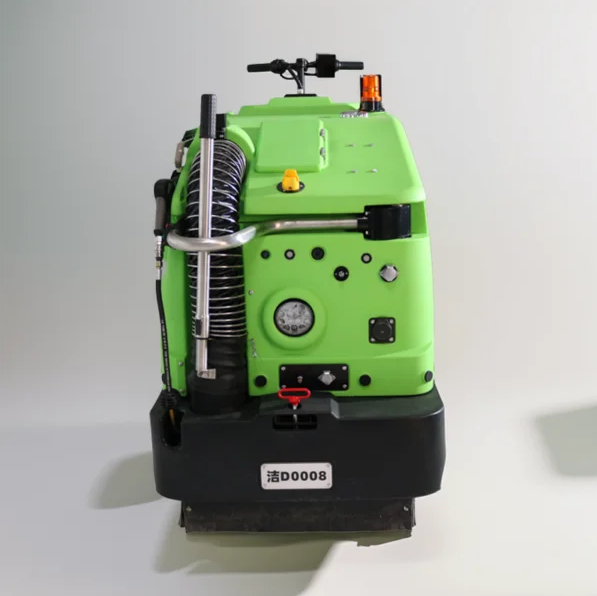
The YJ80 from Greendorph is built around human-machine cooperation and six cleaning functions. It supports self-following through a UWB positioning module, with a following range of 1 to 6 m and an angle range of ±60°. It also provides a high-pressure water gun at about 15 MPa, a 120 L water tank, and a 100 L waste bin.
Its extendable side brush expands the cleaning width to 140 cm, while the stated cleaning efficiency is 10,800 m²/h. The model supports remote operation through a mobile app and cloud platform. These functions can be useful in streets, parks, squares, and similar areas where cleaning tasks may change during one shift.
A machine for cleaning floors should therefore be selected by task rather than by one specification alone. Cleaning width may matter in open zones, while maneuverability may matter more in narrow paths. Water capacity, waste capacity, battery runtime, sensing range, and remote control should be assessed as parts of one working system.
Management Practices Shape Daily Results
Machine capability cannot replace clear management. Supervisors still need inspection routines, charging schedules, water and waste handling, maintenance checks, and defined responsibilities. These steps help keep performance more stable between different days and teams.
Remote platforms can support this work when several machines are deployed. Managers can assign tasks, review progress, and respond when a machine stops or reports an abnormal condition. For larger sites, this can reduce the time spent checking each unit manually.
Maintenance also affects consistency. Brushes, sensors, water systems, wheels, and waste containers should be checked at planned intervals. Dirty sensors or worn cleaning parts can weaken results even when the machine still follows its route.
A More Structured Approach to Cleaning
Safer and more consistent cleaning does not come from automation alone. It comes from combining suitable equipment with clear routes, defined cleaning standards, obstacle awareness, maintenance routines, and practical site rules. When these elements work together, cleaning becomes easier to repeat and easier to review.
For B2B buyers, the useful question is whether the system can reduce variation, lower repeated work, and give teams better control over daily cleaning. That approach keeps equipment selection practical and ties machine capabilities to measurable site needs.