Factory floors face constant pressure from dust, packaging scraps, oil traces, tire marks, and material residue. These contaminants do more than affect appearance. They can interfere with movement, increase slip risks, and make routine inspection harder. For production managers, cleaning is part of daily site control rather than a separate housekeeping task.
The right industrial cleaning machine helps teams remove debris more consistently across workshops, loading zones, corridors, and storage areas. An industrial floor scrubber machine can reduce repeated manual work when the floor condition, cleaning route, and task frequency are suitable. The practical value comes from matching the machine to the real production environment.
Cleaning Needs Change Across Factory Zones
Factory floors are rarely uniform. Assembly areas may mainly collect dust and small scraps, while loading zones can bring in sand, tire marks, and outdoor dirt. Warehouses may have narrow aisles, while open production zones can require longer cleaning routes. One cleaning method may not suit every part of the site.
Floor material also matters. Epoxy floors, concrete surfaces, coated floors, and outdoor paved areas respond differently to water, brushes, pressure, and repeated traffic. Before choosing equipment, we recommend checking floor strength, drainage conditions, aisle width, turning space, and the type of contamination that appears each day.
Cleaning frequency should also reflect production rhythm. A site with several shifts may need shorter cleaning cycles between work periods. Another factory may focus on deep cleaning after daily production. Clear scheduling helps reduce interference with forklifts, workers, and material movement.
Machine Capacity Should Match the Workload
Cleaning width and operating efficiency directly affect how long a route takes. Wider coverage can be useful in open areas, but narrow passages need more flexible movement. Water tank size and waste capacity also influence how often operators must stop for refilling or emptying.
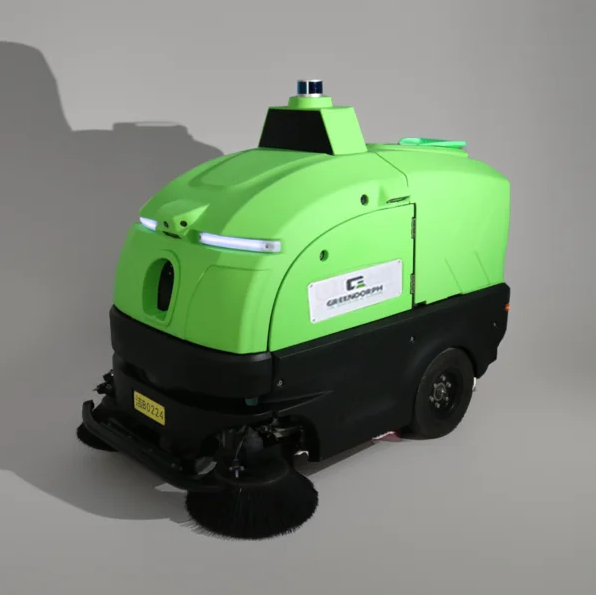
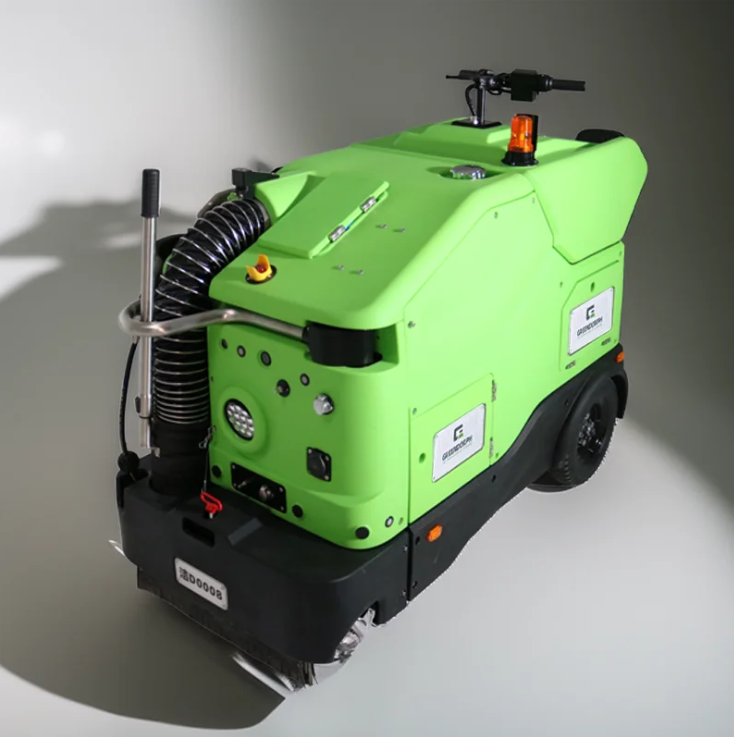
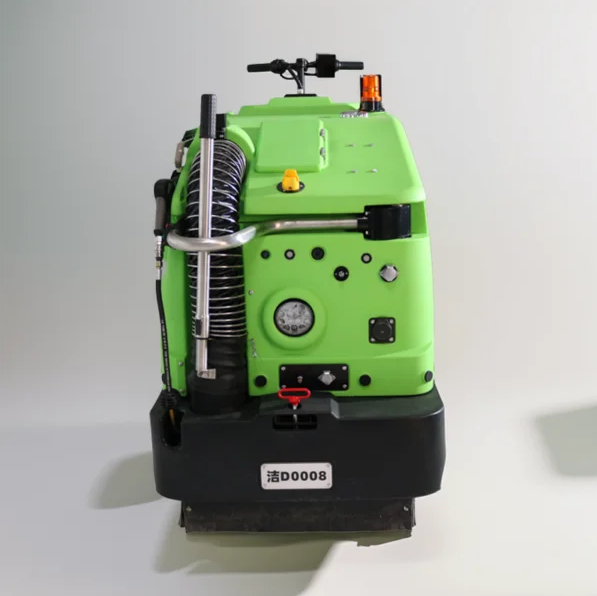
For example, the YJ80 has a 120 L water tank and a 100 L waste container. Its extendable side brush can increase the cleaning width to 140 cm, and the stated sweeping efficiency is 10,800 m²/h. These figures help with planning large paved areas, though suitability still depends on floor type and task design.
Its operating time is 6–8 hours, which can support longer cleaning periods before charging. When evaluating equipment for production sites, we suggest comparing runtime with shift length, route distance, charging arrangements, and the number of cleaning cycles required each day.
Automation Can Reduce Repetitive Work
Factories increasingly look at automation when cleaning routes are repetitive and labor is difficult to allocate. Sensors, remote control, mapping, and task scheduling can reduce the need for continuous manual steering. These functions are useful when the cleaning area is large and routes are predictable.
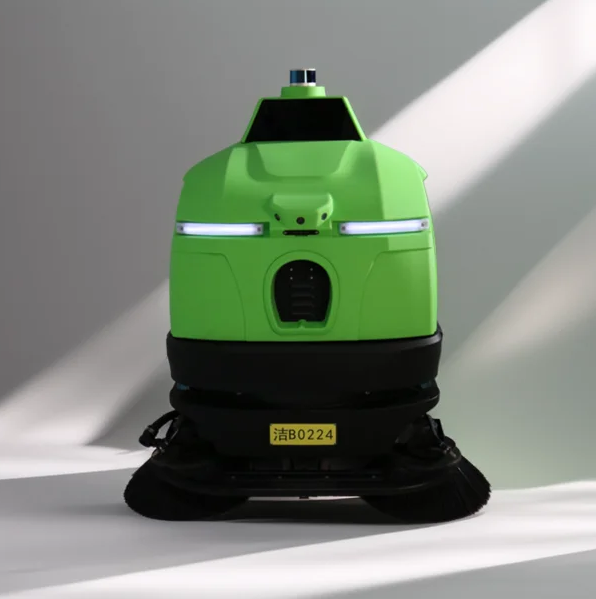
At Greendorph, we develop cleaning equipment with functions such as multi-sensor perception, remote platforms, and task control. The YJ80 combines multi-line lidar, single-line lidar, 3D cameras, and ultrasonic sensors. Its follow mode uses UWB positioning, with a stated following range of 1–6 m and an angle range of ±60°.
For factories, these functions can support safer route management and more flexible task organization. However, automation does not remove the need for site planning. Routes still need to account for moving equipment, temporary obstacles, restricted areas, and changing production layouts.
Scrubbing Performance Depends on More Than Power
When buyers compare an industrial floor scrubber machine, motor power alone should not drive the decision. Brush contact, water delivery, floor pressure, detergent compatibility, turning radius, and recovery performance all affect cleaning results. Maintenance access is also important because brushes, hoses, tanks, and filters require routine attention.
Contamination type should guide the cleaning method. Dry dust may need sweeping or vacuuming first. Oil residue may require a compatible cleaning agent. Heavy deposits can need pre-treatment before scrubbing. Using the wrong process can increase water use or spread dirt instead of removing it.
Operators should also consider how the machine handles edges, corners, and low-clearance areas. These locations often collect residue because larger equipment cannot reach them easily. A practical cleaning plan usually combines machine cleaning with targeted manual work rather than relying on one method for every surface.
Planning Makes Cleaning More Consistent
A cleaner production area depends on repeatable procedures. We recommend mapping cleaning zones, setting task frequency, defining refill and waste-disposal points, and recording recurring contamination. This helps teams identify where dirt comes from and whether the cleaning schedule matches production activity.
Remote functions can also support multi-machine coordination. The YJ80 provides remote control through a mobile app and cloud platform, allowing tasks to be issued and machines to be managed from a distance. This can be useful for large sites where cleaning equipment operates across several work zones.
At Greendorph, we view equipment selection as one part of site management rather than a stand-alone purchase. Cleaning performance improves when machine capability, floor conditions, operator procedures, and maintenance routines are evaluated together.
Cleaner Floors Begin With Better Task Design
Factory cleaning works better when managers start with the production environment instead of only comparing machine specifications. Floor material, contamination type, route width, traffic, runtime, water capacity, and maintenance access all affect daily results.
A suitable industrial cleaning machine can reduce repetitive manual work and support more regular cleaning across appropriate production areas. The key is to match the cleaning method to real site conditions, then build a clear operating routine around the equipment.