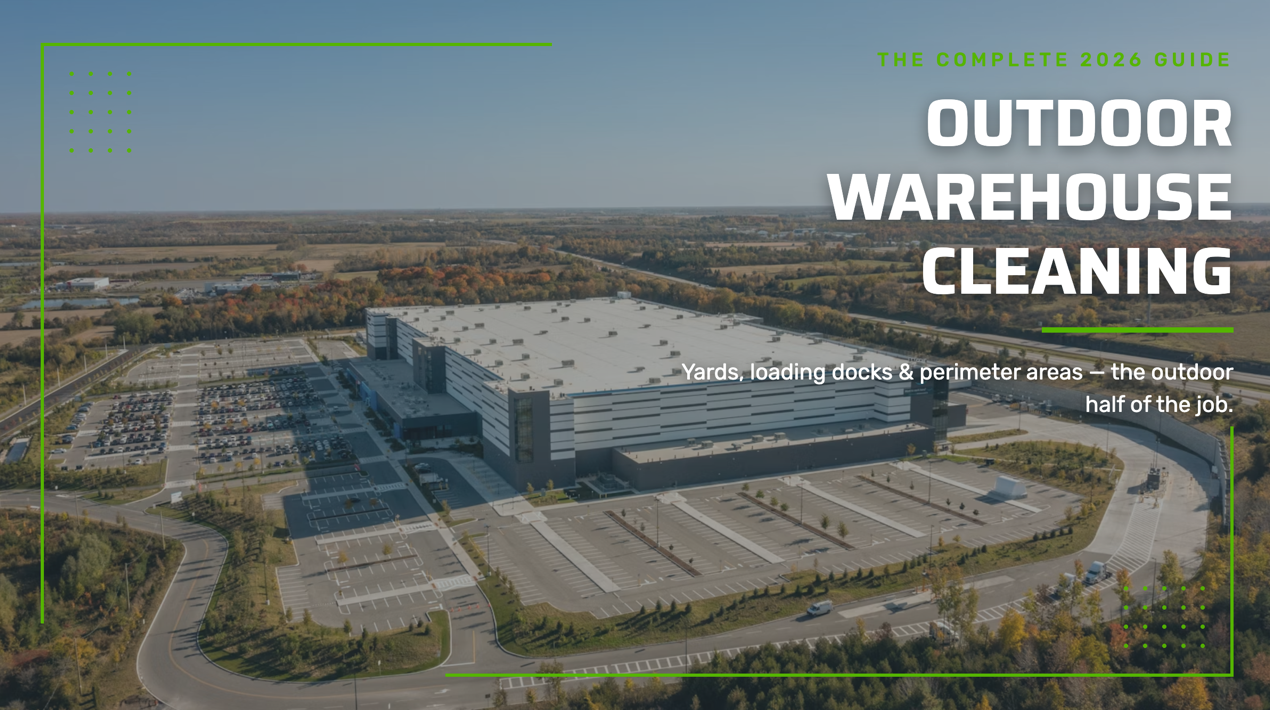
Most “warehouse cleaning” content covers what happens inside the four walls: swept floors, polished concrete, clear aisles. But the yard, the loading docks, and the perimeter drive most of the actual safety and compliance risk at a distribution facility, and they rarely get the same attention as the warehouse floor.
This guide covers the outdoor half of the job: why it matters, the six zones that need a cleaning plan, what equipment fits each one, and when it makes sense to move from a manual crew to an autonomous sweeper. It’s written for facility managers, environmental health and safety (EHS) teams, and operations directors running sites where the yard sees as much traffic as the floor.
Why Outdoor Warehouse Cleaning Matters
Safety. Warehousing and storage carries a recordable injury rate of 4.8 per 100 workers, well above the 2.7 per 100 average across all private industry, which is why the Occupational Safety and Health Administration (OSHA) runs a dedicated national emphasis program on the sector [1]. Loose debris tracked in from the yard, oil drips near the dock, and gravel scattered across access roads all feed into that gap. OSHA’s walking-working surfaces standard requires floors to be kept clean and dry and aisles kept clear of obstructions, a requirement that starts at the point debris enters the building, not just inside it [2].
Operations. Sharp debris on transport paths wears down forklift tires faster, and loose gravel or brick fragments left on dock approaches turn into a recurring maintenance cost rather than a one-time cleanup. Keeping access roads and dock aprons clear also keeps traffic moving during shift changes, when yard congestion costs the most.
Compliance. Facilities with exposed industrial activity generally need a Stormwater Pollution Prevention Plan (SWPPP) under the Environmental Protection Agency’s (EPA) industrial stormwater permit program, and routine sweeping is listed as a standard best management practice (BMP) for keeping pollutants out of runoff [3]. A yard that accumulates loose material between storms is the kind of gap an inspector looks for first.
Contract retention. Many warehouses operate as third-party logistics (3PL) sites for large retail clients, and those clients routinely send auditors to check yard and dock conditions as part of ongoing contract compliance. A facility that can’t show consistent cleanliness standards risks losing the account, not just failing a walkthrough.
The 6 Outdoor Cleaning Zones of a Warehouse
| Zone | What happens there | Typical debris load |
|---|---|---|
| Truck yards & access roads | Continuous trailer and forklift traffic | Highest, daily accumulation |
| Loading docks & dock approaches | Loading, unloading, staging | High, concentrated near dock doors |
| Trailer parking & marshaling areas | Overnight and staging trailer storage | Moderate |
| Perimeter & fence lines | Low traffic, exposed to wind | Moderate, wind-driven |
| Employee parking lots | Daily foot and vehicle traffic | Moderate |
| Internal roads between buildings | Connects zones, moderate traffic | Low to moderate |
Debris Profile by Zone
The right equipment for a zone depends on what’s actually landing on the ground there, not a generic “outdoor debris” assumption.
- Yards and access roads: gravel, dust, leaves, packaging debris, mud tracked from trailer tires
- Loading docks: cardboard fragments, paper, packaging waste, occasional liquid spills
- Parking areas: leaves, sand, sediment, general litter
- Perimeter zones: windblown dust, vegetation debris, litter carried in from outside the fence line
Docks and yards need the most frequent attention because debris there directly affects forklift traffic and dock-door function. Perimeter zones can usually run on a lighter schedule.
Equipment Options
Manual crews still make sense for small sites or zones with irregular, unpredictable debris, like a loading dock after a specific delivery. They’re flexible but don’t scale well across large yards, and labor availability for outdoor sweeping roles has gotten tighter industry-wide.
Towed sweepers (yard tractor attachments) work well for large open yards where a facility already runs a tractor for trailer spotting. They add sweeping capability without a dedicated machine, but someone still has to run the tractor for that purpose.
Manual ride-on outdoor sweepers cover more ground per hour than a walking crew and handle both dry sweeping and, on some models, wet washing in one pass. They still need an operator, which matters for tight or frequently reconfigured zones like dock approaches.
Vacuum trucks (regenerative-air) are built for heavy-duty debris and large paved areas, common at very large distribution hubs, but represent a bigger equipment investment than most single-facility operations need.
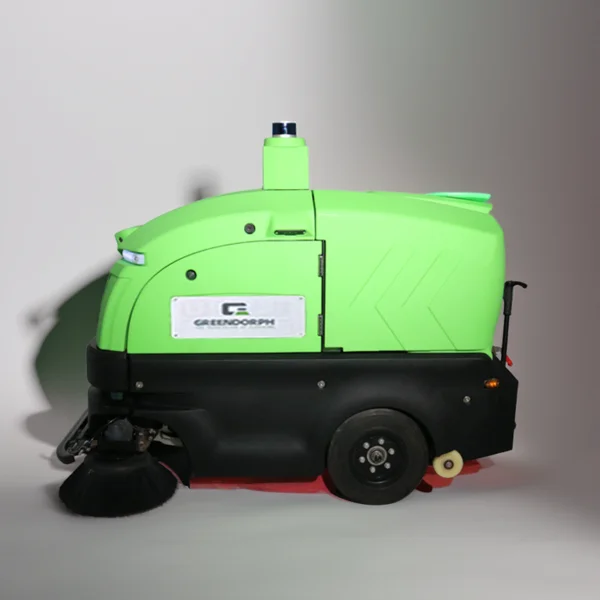
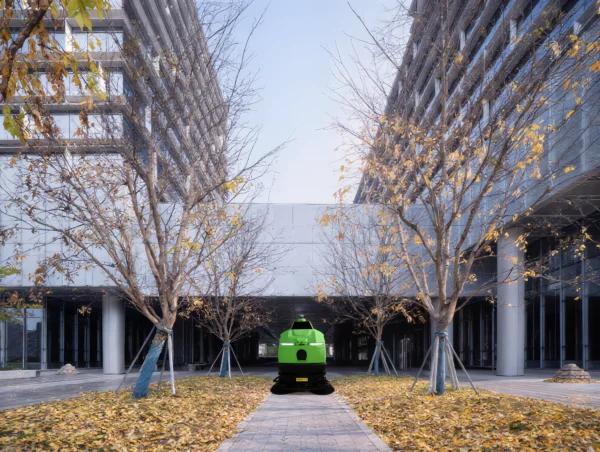
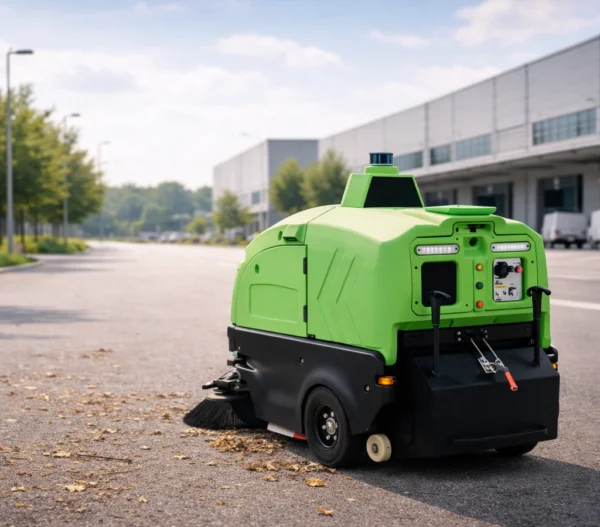
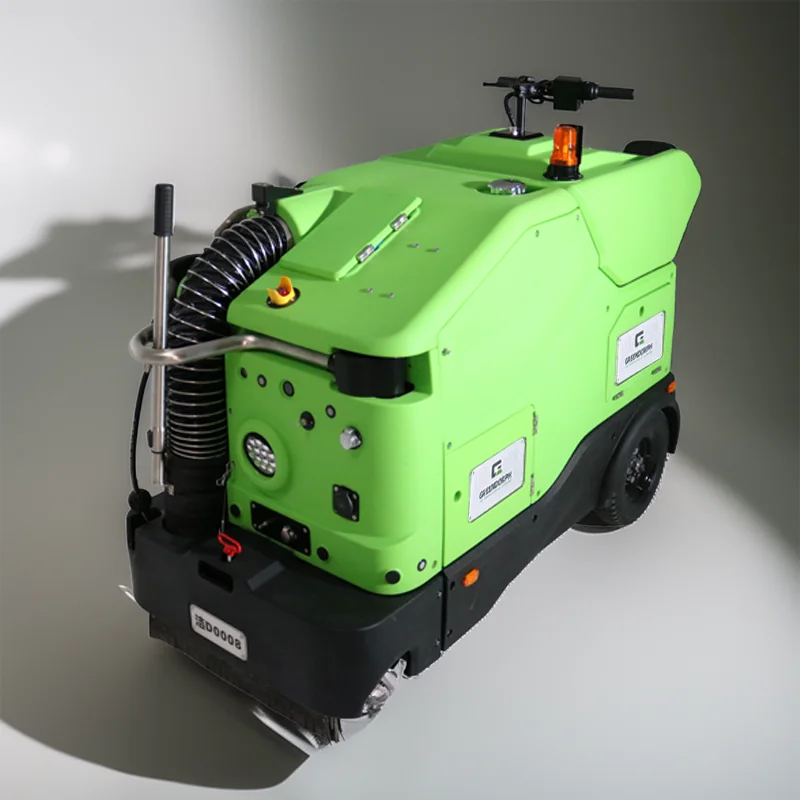
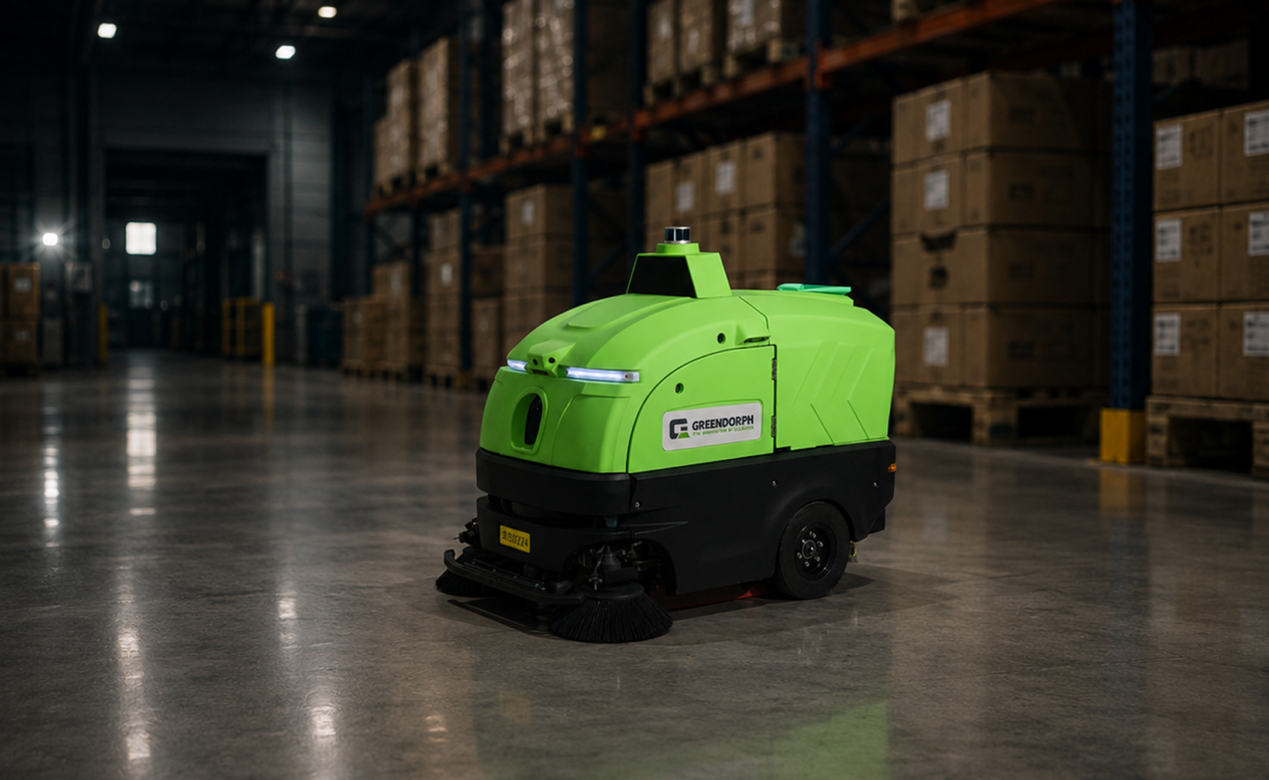
Autonomous outdoor sweepers run scheduled routes without an operator once mapped, which suits large, continuous, relatively predictable zones like open yards and perimeter loops. The Greendorph Auto Sweeper YJ130 is built for this category, one of several warehouse sweeping scenarios Greendorph engineers for, with a 130 cm cleaning width, 5,760 m²/h efficiency, and auto water refill, waste dumping, and recharging for unattended operation [4]. For mixed dock approaches and narrower lanes where layouts shift, the Greendorph Omniclean YJ80 offers manual, auto-follow, and towed control modes in a more compact 860 mm body [5].
Matching equipment to zone comes down to three variables: area size, how predictable the debris and layout are, and how much operator time the facility can allocate. Large, predictable zones favor autonomous coverage. Small or unpredictable zones favor manual or ride-on flexibility.
7 Best Practices for Outdoor Warehouse Cleaning
- Build a zone-based cleaning plan with frequency tiers.Docks and yards need daily or near-daily attention; perimeter zones can run weekly or biweekly.
- Stay ahead of stormwater compliance.Keep sweeping logged as part of your SWPPP’s documented BMPs, not as an informal habit [3].
- Schedule around dock and traffic flow.Clean access roads and dock aprons during low-traffic windows to avoid interfering with loading operations.
- Control dust without overusing water.Misting and airflow-assist functions cut down on excess water use compared to a full wash-down for routine dust control.
- Integrate cleaning with safety walks.Pair sweeping schedules with routine foreign object debris (FOD) checks near dock doors and forklift paths.
- Document everything.Digital logs of coverage and timing hold up better in an audit or OSHA inspection than a paper sign-off sheet.
- Plan for seasonal shifts.Leaf litter in fall, salt and grit in winter, and dust in summer each change what a zone’s cleaning plan needs to handle.
When to Move from Manual to Autonomous
The switch usually makes sense once a site clears three thresholds: total outdoor area large enough that a manual crew can’t finish a full loop in one shift, cleaning needs that run across multiple shifts or 24/7 operations, and labor costs that make unattended coverage pay back faster than adding headcount. Grounds maintenance labor carries a median hourly wage of $18.50 nationally, a baseline worth comparing against a machine’s coverage rate per hour rather than its purchase price alone [6].
Greendorph’s own case work shows what that shift looks like in practice. At Austral Bricks’ Wollert Plant in Victoria, Australia, a heavy manufacturing facility, site management needed to remove workers from a “dual hazard” zone where fine silica dust and forklift traffic overlapped near transport paths [7]. Sharp gravel and brick shards on those paths were also acting as a persistent source of forklift tire wear before the switch [7]. A YJ130 was deployed with its negative-pressure collection and water misting to trap dust at the source, and its reinforced intake was rated to clear stones and brick shards up to 50mm, running continuous loops while staff stayed clear of the highest-risk zones [7].
A short pilot on your own site, mapping just the highest-traffic zone first, is the lowest-risk way to test whether the payback holds before committing to full-yard coverage.
Matching the Right Robot to Your Outdoor Layout
Greendorph builds two outdoor cleaning lines, and each fits a different part of the six-zone breakdown above. For large open yards and perimeter loops, the fully autonomous YJ130 runs scheduled routes with minimal supervision, drawing on 150-liter debris and 100-liter water capacity for extended coverage between refills [4]. For dock approaches, narrow lanes, and marshaling areas where layouts shift more often, the semi-autonomous YJ80 Omniclean offers manual, auto-follow, and towed modes with both dry and wet cleaning in one chassis [5].
Neither machine is built for indoor carpeted areas, so a warehouse with a carpeted office wing alongside its outdoor yard will need separate equipment for that space. For the outdoor hard-surface zones covered in this guide, matching machine to zone size and layout predictability matters more than picking the highest-spec option available.
FAQ
How often should outdoor warehouse yards be cleaned?
High-traffic zones like docks and access roads generally need daily or near-daily sweeping, while lower-traffic perimeter areas can run on a weekly or biweekly schedule. The right frequency depends on debris load, not a fixed calendar.
What’s the difference between sweeping and vacuum-sweeping outdoors?
Basic sweeping displaces debris into a pile or windrow, while vacuum-sweeping collects it directly into an onboard bin. Vacuum-sweeping is generally better for fine dust and small debris that a mechanical broom alone would leave behind or kick back into the air.
Do autonomous outdoor sweepers operate safely with forklift and yard truck traffic?
Machines built for industrial yards use sensor fusion, LiDAR, and cameras to detect vehicles and yield automatically rather than relying on a fixed route regardless of traffic [4]. Confirm a specific model’s obstacle detection range and response behavior before deploying it in an active traffic zone.
What about rain and snow?
Outdoor-rated sweepers are generally built for exposure to rain and dust, but check the specific weather rating before committing to year-round outdoor operation. Snow and ice typically require separate equipment rather than a standard sweeper.
How does outdoor cleaning tie into SWPPP compliance?
Routine sweeping is a standard best management practice under EPA’s industrial stormwater program, since it keeps loose material from washing into stormwater discharge points during rain events [3]. Documented, repeatable sweeping schedules give facilities something concrete to show during a stormwater inspection.
What’s the typical cost of outdoor warehouse cleaning per square foot?
Costs vary too widely by region, labor rates, and equipment choice to state a reliable blanket figure. Compare quotes based on your actual site’s square footage, debris load, and required frequency rather than a generic industry number.
Conclusion
The floor inside a warehouse gets swept because it’s visible. The yard, docks, and perimeter get neglected because they’re not, even though they carry more of the safety and compliance risk. Building a zone-based plan, matching equipment to each zone’s size and predictability, and documenting the work turns outdoor cleaning from an afterthought into part of the facility’s actual risk management.
If you’re evaluating whether autonomous coverage fits your site, a demo request with real yard measurements is a faster way to get a specific answer than estimating from general guidance alone.
Sources
- “OSHA Announces National Emphasis Program for Warehousing and Distribution Center Operations.” U.S. Department of Labor, 2022. https://www.dol.gov/newsroom/releases/osha/osha20220817
- “1910.22 – Walking-Working Surfaces, General Requirements.” Occupational Safety and Health Administration. https://www.osha.gov/laws-regs/regulations/standardnumber/1910/1910.22
- “Developing Your Stormwater Pollution Prevention Plan: A Guide for Industrial Operators.” U.S. Environmental Protection Agency, EPA 833-B-09-002, 2021. https://www.epa.gov/sites/default/files/2021-03/documents/swppp_guide_industrial_2021_030121.pdf
- “Greendorph Auto Sweeper YJ130 – Robot Floor Cleaner.” Greendorph (Shenzhen Yunjie Technology Co., Ltd.), 2026. https://greendorphrobot.com/robot-floor-cleaner-greendorph-auto-sweeper-yj130/
- “Greendorph Omniclean Urban Street Sweeper YJ80 – Robot Floor Cleaner.” Greendorph (Shenzhen Yunjie Technology Co., Ltd.), 2026. https://greendorphrobot.com/robot-floor-cleaner-greendorph-omniclean-urban-street-sweeper-yj80/
- “Grounds Maintenance Workers.” Occupational Outlook Handbook, U.S. Bureau of Labor Statistics, May 2024 data. https://www.bls.gov/ooh/building-and-grounds-cleaning/grounds-maintenance-workers.htm
- “Industrial Park Cleaning Solutions — The Austral Bricks Case Study.” Greendorph (Shenzhen Yunjie Technology Co., Ltd.), 2026. https://greendorphrobot.com/industrial-parks/